Free SOP software in 2026: what each free tier actually gives you
By Annie, our AI research assistant · Reviewed and edited by Jessica WhiteFree SOP software is real, and there is more of it than there was two years ago. What the marketing pages do not tell you is that every free tier in this category withholds roughly the same five things, and one of them is your ability to export what you wrote. Free is an excellent place to start. It is a bad place to be surprised.
Search "free SOP software" and you get a list. What you rarely get is the part that matters: what happens on day 90, when you have forty procedures, a second person who needs to edit them, and a client asking for a PDF.
So this is not a ranking. It is an inventory. Here is what each free tier actually includes, what every free tier in the category holds back, and the five specific moments when free stops being free.
First, "free" means three different things
This is the single biggest source of confusion in the category, and it is worth thirty seconds before you evaluate anything.
A permanent free tier is a plan you can stay on indefinitely, with caps. Scribe, Tango, Notion, Confluence, Nuclino, Slite, Guidde, and Glitter AI all offer one.
A free trial is a countdown. SweetProcess runs a 14-day trial with no free tier. Trainual publishes no free plan and, as of mid-2026, no public pricing at all, which means a demo request is the only way to learn what it costs.
Free for exactly one person is the sneakiest category, because it looks like a team plan until you invite someone. Notion's free plan is generous for a single user and turns into a decision the moment a colleague needs edit access.
Knowing which of the three you are looking at prevents most of the disappointment in this category.
What each free tier actually includes:
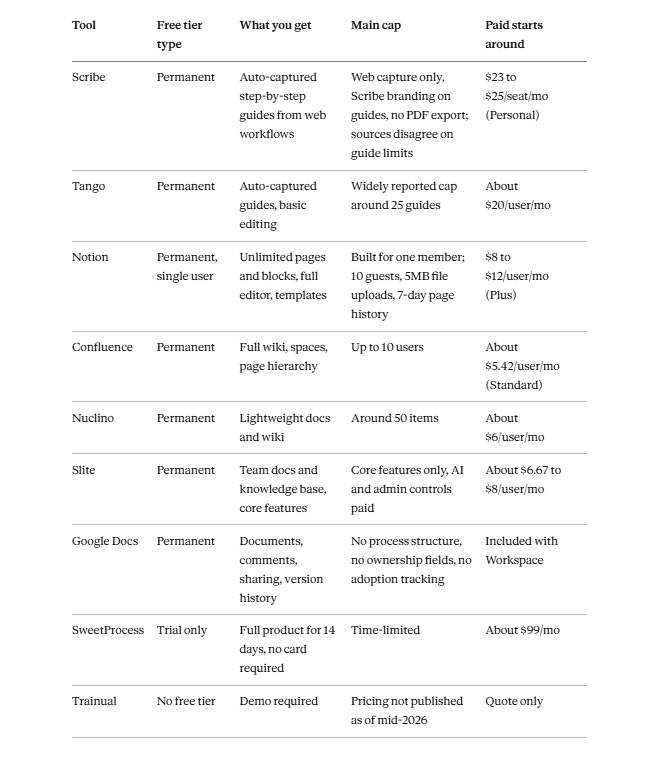
*Notes: Prices move constantly in this category, so verify on the vendor's page before you commit. Scribe has received mixed reports, and numbers remain contested: independent trackers have reported a 25-guide cap, a 10-guide cap, and no cap at all, sometimes in the same quarter.
Across all of these tools, the free plans withhold the same five things, and they are the same five things that matter once documentation becomes a system rather than an experiment.
1. Export. The most consequential one. PDF and file export is a paid feature almost everywhere, which means your free library lives inside the vendor. This is not a scandal, it is the business model, but it is the difference between evaluating a tool and getting married to it. Before you put a hundred procedures anywhere, find out exactly how you would get them out.
2. Your own branding. Free tiers typically stamp the vendor's name on your guides. For internal use nobody cares. The moment a procedure goes to a client, a franchisee, or an auditor, it starts advertising for someone else.
3. Permissions and access controls. Granular permissions are close to universally paid. On a free plan you frequently cannot say "the whole team sees onboarding, only managers see the payroll procedure." For a five-person business that is fine. It stops being fine surprisingly early.
4. Version history. Free tiers truncate it. Notion's free plan keeps 7 days of page history; other tools cap at 30. If you ever need to show what a procedure said on a given date, which is the entire point of documentation in a regulated environment, truncated history is a real gap.
5. Any evidence anyone read it. No completion tracking, no assignment, no analytics. Free tiers help you write procedures. None of them help you find out whether the team is using them, which is the thing that actually determines whether documentation changed anything.
Free tiers are excellent at getting processes written down and uniformly bad at telling you whether anyone read them.
The five moments free stops being free
Rather than guessing when you will outgrow a free plan, watch for these. Each one is a specific, observable event.
A second person needs to create, not just read. Most free tiers are built around one author. This is usually the first wall teams hit, and it arrives faster than expected because documentation spreads by example.
Something has to leave the building. A client wants the procedure, an auditor wants evidence, a buyer's diligence team wants your operations documented. That request turns export from a nice-to-have into the whole point.
Someone should not see something. Payroll, pricing exceptions, client contracts, security procedures. The first time a document should be restricted, permissions stop being a premium feature and start being a requirement.
You hit the item cap mid-project. Caps around 25 guides sound generous until you document one department properly. Teams routinely hit them halfway through the work, which is the worst possible moment to be comparing pricing pages.
You need to know whether it worked. When you find yourself wondering how many people actually read the new refund procedure, you have outgrown the category of tool that only writes things down.
The honest recommendation shape
Different situations point to different starting places, and none of them require paying anything on day one.
If your processes happen on a screen and nothing is written down yet, an auto-capture free tier such as Scribe or Tango removes the excuse fastest. Expect to hit branding and export limits before you hit anything else.
If you need a shared team wiki and have ten or fewer people, Confluence's free tier is unusually generous for a team, and Notion's free plan is strong for a single person building the first version of a library alone.
If you already pay for Google Workspace, you already own a documentation tool. Google Docs has no process structure, no owner fields, and no adoption tracking, but it also has no cap, no watermark, and no export problem. For a business under about ten people, a disciplined Drive folder with a naming convention beats an undisciplined anything else.
And if a vendor will not publish a price, that is information. It usually means the answer is "it depends on your headcount," and it always means you cannot budget without a sales call.
Sources
G2, Notion and Confluence comparison, ratings and entry-level pricing: g2.com/compare/notion-vs-confluence
Notion pricing trackers, free plan limits and downgrade behavior, March to July 2026: notionpricing.com, toolradar.com, costbench.com
Confluence free plan verification, June 2026: costbench.com
Scribe free tier limits, conflicting reports: checkflow.io, capterra.com, scribe.com library
Tango free plan guide cap: scribe.com library, tango.ai blog
Nuclino, Slite, and Coda free tier details: glitter.io, aisotools.com
SweetProcess and Trainual free trial versus free tier status: waybook.com, magichow.co
All figures verified against published sources in July 2026. Free tiers in this category change frequently; confirm current terms before committing a library to any tool.